
Most working IGF-1 LR3 protocols cluster between 20 and 100 mcg per day, with the majority of experienced users settling into a 20 to 50 mcg/day range once a beginner cycle is complete. The single most important safeguard at any dose is glucose monitoring: because IGF-1 LR3 cross-reacts with insulin receptors, hypoglycemia is the acute risk that ends self-experimentation badly. Keep fast-acting carbohydrates within reach every time you dose. The tiers, technique, and math behind that verdict follow below.
TL;DR:
- Most users dose between 20 and 50 mcg daily, with higher doses above 60 mcg only suitable for experienced individuals with monitoring routines.
- Glucose monitoring is critical during use, as IGF-1 LR3’s cross-reactivity with insulin receptors can cause dangerous hypoglycemia, especially at higher doses.
- Dosing is best after workouts to take advantage of increased receptor sensitivity and nutrient partitioning, with subcutaneous injection being the standard route.
- Accurate dilution and label management are essential to prevent dosing errors, as switching dilutions mid-cycle can accidentally double doses.
- Shorter cycles with proper washouts are safer, and staying within the 20-50 mcg range reduces hypoglycemia risks more effectively than pushing toward the maximum dose.
Table of Contents
- IGF-1 LR3 Dosage Guidelines by Experience Level
- When and How Should You Inject IGF-1 LR3?
- How Do You Reconstitute and Store IGF-1 LR3?
- What Are the Safety Risks of IGF-1 LR3?
- Can You Stack IGF-1 LR3 With Other Peptides?
- How Do You Calculate an IGF-1 LR3 Dose?
- How Reliable Is the Evidence Behind These Protocols?
- Why Harm Reduction Beats Chasing the Ceiling
- Get a Precise, Personalized IGF-1 LR3 Protocol
- Sources
- FAQ
IGF-1 LR3 Dosage Guidelines by Experience Level
There is no validated human clinical trial establishing an optimal IGF-1 LR3 dose. Every protocol you will read, including this one, extrapolates from preclinical work, receptor physiology, and years of aggregated community-reported dosing ranges. That gap is exactly why tiered, conservative escalation matters more here than with compounds backed by dosing trials.
Beginner protocol. Start at 20 mcg/day and hold that dose for the first 3 to 4 days before deciding whether to continue. Many first-cycle users stop at 20 to 30 mcg/day for the entire run, which typically spans 4 to 6 weeks, followed by a washout of equal or greater length. Do not step up until you have confirmed stable fasting glucose and no symptoms of hypoglycemia at the current dose.

Intermediate protocol. Once a beginner cycle has been completed without adverse signals, the working range moves to 40 to 60 mcg/day. This is where most self-experimenters land long term. Some intermediate users split this into a shorter, more aggressive 10-day protocol at the higher end of the range with a 4-week washout, rather than running a continuous 6-week cycle. Splitting the daily dose into two administrations is occasionally reported for tolerance reasons, but single daily dosing remains standard given the compound’s extended systemic availability.
Advanced protocol. Doses above 60 mcg/day, up to the commonly cited ceiling of 100 mcg/day, belong only to users with a documented history of tolerance at lower doses and an established glucose-monitoring routine. Advanced users occasionally split a higher total dose across two injections to blunt the glucose swing of a single large bolus, but this adds injection burden without added evidence of better outcomes. Routine dosing at the top of the range is not something the current evidence supports as a default strategy. It is a ceiling, not a target.
When to hold or stop escalating:
- Fasting glucose readings trending below your personal baseline by more than 15 to 20 points.
- Any symptom cluster consistent with hypoglycemia, including shakiness, cold sweats, confusion, or unusual hunger within two hours of dosing.
- Injection site reactions that worsen rather than resolve within 48 hours.
- Persistent joint pain or numbness, which can signal excess growth-factor signaling in soft tissue.
- No measurable subjective or lab-based benefit after a full beginner cycle, which is a signal to reassess rather than escalate.
Cycle length itself is a safety lever as much as a dosing number. The PubMed literature on IGF-1 physiology supports the general principle that shorter cycles with real washout periods reduce the risk of receptor desensitization compared to continuous, months-long use at any dose.
When and How Should You Inject IGF-1 LR3?
Most experienced users dose post-workout rather than in a fasted morning state, and the rationale is mechanical, not just habitual. Training already increases nutrient partitioning and receptor sensitivity, and IGF signaling operates through the mTOR pathway that governs anabolic response to exercise. Dosing into that window aligns the peptide’s action with a state your body is already primed for, and it avoids adding IGF-driven glucose uptake on top of an already-depleted fasting glucose level, which is when hypoglycemia risk peaks.

Subcutaneous injection is the standard route because it supports steady systemic absorption rather than a rapid, localized effect. Intramuscular injection is occasionally used by advanced self-experimenters targeting a specific muscle group, but it increases both injection-site trauma and the speed of absorption, which sharpens the glucose drop. If you are early in your experience with this compound, stay subcutaneous.
Injection technique, step by step:
- Wash your hands and swab the injection site and vial top with alcohol.
- Draw the calculated dose slowly, tap out air bubbles, and confirm the syringe reading twice.
- Pinch a fold of subcutaneous fat at the site, typically abdomen or upper thigh.
- Insert the needle at a 45 to 90 degree angle depending on syringe length and body fat.
- Inject slowly, withdraw, and apply light pressure with a clean gauze pad.
- Log the site, dose, and time immediately so rotation stays on track.
Do not dose for the first time before driving, operating machinery, or going to sleep. You will not know how your body responds until you have observed a full dosing window while awake and able to react to symptoms.
How Do You Reconstitute and Store IGF-1 LR3?
Reconstitute with bacteriostatic water only, and let the stream run down the vial wall rather than hitting the lyophilized powder directly. Swirl gently to dissolve. Shaking introduces mechanical stress that can degrade the peptide’s structure, and handling guidance for peptide stability consistently favors gentle mixing and cold storage over convenience.
Two dilutions cover most protocols:
- 1 mg + 1 mL bacteriostatic water = 1,000 mcg/mL, a concentrated mix that keeps injection volumes small.
- 1 mg + 2 mL bacteriostatic water = 500 mcg/mL, which doubles the volume per dose and can improve measurement accuracy on lower-resolution syringes.
Refrigerate the reconstituted vial immediately at standard fridge temperature, and treat 14 to 21 days as a conservative outer limit for potency, even though some users report stability beyond that window. Never store at room temperature for more than the brief period needed to draw a dose. Use a single vial for one person only, and always swab the septum before each draw. Multi-use vials carry real contamination risk if that step gets skipped even once.
What Are the Safety Risks of IGF-1 LR3?
Hypoglycemia is not a theoretical side effect. IGF-1 LR3 shares enough structural similarity with insulin that it binds and activates insulin receptors, driving glucose into cells the same way insulin does. That is documented cross-reactivity in the endocrine physiology literature, and it means the glucose-lowering effect scales with dose. Higher doses do not just build more, they drop blood sugar harder.
Statistic Callout: Insulin-receptor cross-reactivity is dose-dependent, meaning the same mechanism that supports anabolic signaling at 20 mcg becomes a meaningfully sharper glucose risk once daily dosing climbs toward the 100 mcg ceiling.
Before starting any cycle, get baseline labs: fasting glucose, HbA1c, and a basic metabolic panel. Monitoring guidance from endocrine safety literature points to weekly self-checks of fasting glucose during titration, tightening to daily checks if you escalate dose or add a stack.
Practical safeguards worth building into every cycle:
- Keep 20 to 30 grams of fast-acting carbohydrate within arm’s reach at every injection.
- Never dose in a fasted state, especially first thing in the morning.
- Do not combine IGF-1 LR3 with exogenous insulin or any insulin-sensitizing medication.
- Test glucose within 60 to 90 minutes of your first several doses at any new dose level.
- Stop dosing and seek medical attention if you experience confusion, loss of coordination, or a hypoglycemic episode that does not resolve with carbohydrate intake within 15 minutes.
Can You Stack IGF-1 LR3 With Other Peptides?
Stacking is common among advanced users, but it raises the monitoring burden significantly and is not a starting point for anyone new to the compound. Growth hormone secretagogues like Ipamorelin are the most frequently reported pairing, typically dosed at separate times of day to avoid overlapping peaks. BPC-157 shows up in stacks aimed at recovery support alongside growth-factor signaling, generally without added glucose risk on its own.
- Exogenous insulin or any insulin-sensitizing drug is contraindicated outright given the shared receptor mechanism.
- Stacking with GH secretagogues means checking glucose more frequently, not less, since both compounds influence metabolic signaling.
- Stagger administration times rather than injecting multiple compounds simultaneously, to make side effects easier to attribute.
- Treat any stack as an advanced-user decision only, after a clean solo cycle with no adverse signals.
How Do You Calculate an IGF-1 LR3 Dose?
The formula is simple, but errors happen when users switch dilutions without recalculating. Concentration (mcg/mL) determines how many mL correspond to your target dose, and a U-100 insulin syringe holds 100 units per mL, so each unit equals 0.01 mL.
| Dilution | Concentration | 20 mcg dose | 50 mcg dose | 100 mcg dose |
|---|---|---|---|---|
| 1 mg + 1 mL BAC water | 1,000 mcg/mL | 0.02 mL (2 units) | 0.05 mL (5 units) | 0.05 mL (5 units) |
| 1 mg + 2 mL BAC water | 500 mcg/mL | 0.05 mL (5 units) | 0.05 mL (5 units) | 0.1 mL (10 units) |
A worked syringe conversion makes the risk obvious: 50 mcg at 1,000 mcg/mL is 5 units, but the identical 50 mcg dose at 500 mcg/mL becomes 10 units. Mixing up which vial you diluted is the single most common dosing error reported in community protocols, and it is entirely preventable with a labeled vial and a second look at your math before you draw.
Pro Tip: Always relabel a freshly reconstituted vial with its exact concentration in marker, and recheck that label against your calculator every single time you switch vials, even if you have used the same dilution ratio for months.
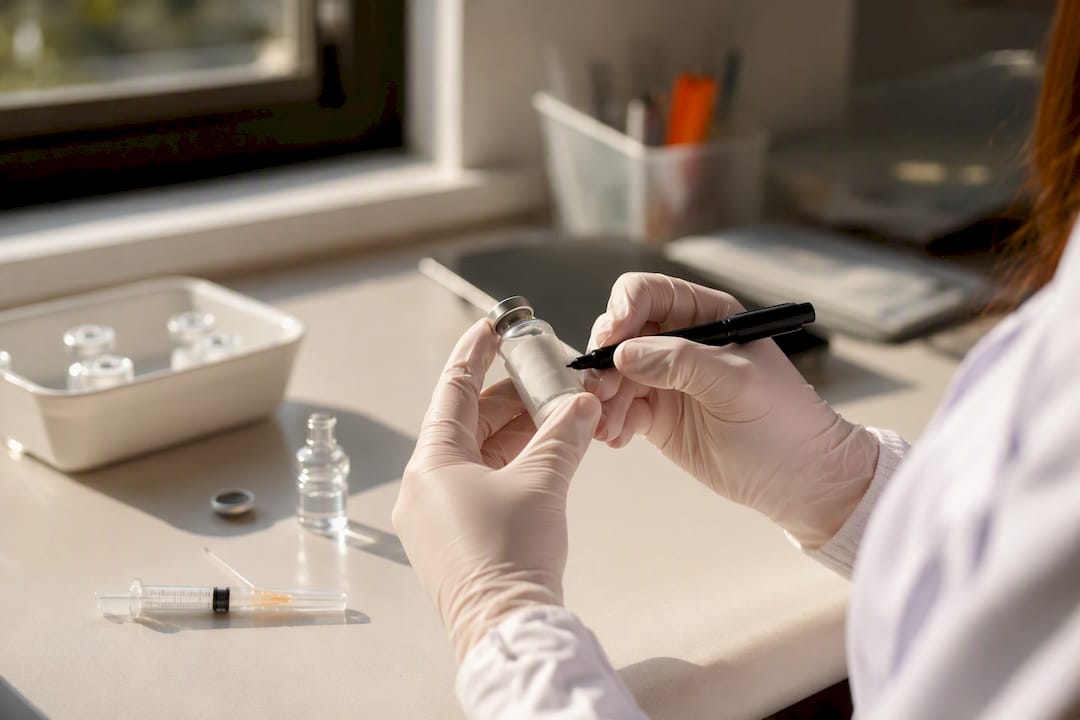
If you want the math done automatically instead of by hand, The Peptide Guide’s dosage calculator tools walk through the same mcg to mL to unit conversion for other microgram-dosed peptides.
How Reliable Is the Evidence Behind These Protocols?
No regulatory body has approved a human dosing protocol for IGF-1 LR3, and no published clinical trial has established a validated therapeutic range for this specific use. The dosing tiers in this guide come from a synthesis of preclinical receptor physiology, applied physiology research on IGF signaling, and years of aggregated community reporting, weighted conservatively toward the lower end of reported ranges wherever the evidence is thin.
Protocol design should prioritize the lowest effective dose and slow titration under objective glucose monitoring, favoring short cycles with genuine washout periods over continuous high-dose use, precisely because human dosing trials do not exist to validate a higher-confidence alternative.
The Peptide Guide builds every protocol page, including its evidence-based peptide protocol standards and its broader peptide function reference, around that same conservative bias. None of this replaces a conversation with a qualified physician, particularly if you have any history of glucose regulation issues.
Why Harm Reduction Beats Chasing the Ceiling
The biggest mistake we see is treating 100 mcg as a target instead of a ceiling most people never need to touch. Readers get more consistent results, and fewer glucose scares, staying in the 20 to 50 mcg range for longer instead of racing up the scale in the first two weeks. Precise syringe math and a glucose meter do more for outcomes than an extra 30 mcg ever will. If you want a more structured plan, The Peptide Guide’s calculators and protocol library exist for exactly that.
— The Peptide Guide
Get a Precise, Personalized IGF-1 LR3 Protocol
Manual syringe math is where most dosing errors start, and switching between a 1,000 mcg/mL and a 500 mcg/mL dilution mid-cycle is a common way to double a dose by accident. The Peptide Guide’s peptide protocol library gives you calculator-driven dosing, monitoring templates, and downloadable cycle logs so you are not doing conversion math by hand every time you draw a syringe.

That toolkit is built for readers who want a structured, trackable cycle rather than a rough mental estimate, but nothing in this guide’s safety steps requires a paid account to use. The glucose-monitoring cadence, injection technique, and escalation triggers above are free and sufficient on their own. If you want the deeper layer, browse the core peptide category or start building your protocol directly from the protocol library today.
This article is general information, not a substitute for advice from a qualified doctor. Consult a qualified healthcare professional about your own circumstances before acting on anything here.
Sources
- PubMed entry related to IGF/IGF-1 physiology
- Insulin-like growth factor I: structure and function (Diabetes journal supplement)
- PMC review article relevant to growth factor biology
FAQ
What Is a Typical IGF-1 LR3 Dosage for Beginners?
Most beginner protocols start at 20 mcg/day for 3 to 4 days before any escalation, held within a 4 to 6 week cycle followed by a washout period.
How Much IGF-1 LR3 Should Experienced Users Take?
Intermediate and advanced users typically work within a moderate to higher dose range, with many settling at mid-range doses rather than routinely dosing near the ceiling.
Is IGF-1 LR3 Dosed Once or Twice Daily?
Once-daily dosing is the typical practice because of the compound’s extended systemic availability, though some advanced users split higher total doses into two injections to reduce the glucose impact of a single bolus.
What Is the Biggest Risk With IGF-1 LR3 Dosing?
Hypoglycemia is the main acute risk, driven by cross-reactivity with insulin receptors, which is why glucose monitoring and having fast carbohydrates on hand at every dose matters more than the exact number of micrograms used.
How Long Should an IGF-1 LR3 Cycle Last?
Most cycles run 4 to 6 weeks with an equal washout period, though some community protocols use a shorter 10-day cycle followed by a 4-week break to reduce receptor desensitization risk.
Recommended
- GLP‑3 ® LY3437943 20mg – Metabolic Optimization Peptide Protocol | The Peptide Guide
- Glucagon-Like Peptide-2 (1-33) 10mg – Research & Dosing Protocol | The Peptide Guide
- Ipamorelin 10mg – Growth Hormone Support Peptide Protocol | The Peptide Guide
- Glucagon-Like Peptide-1 (7-36) 10mg – Research & Dosing Protocol | The Peptide Guide


