
TL;DR:
- Proper handling and storage are essential to maintain peptide potency and prevent silent degradation.
- Use aseptic techniques, correct reconstitution methods, and appropriate storage conditions for optimal results.
- Consistent process discipline and careful documentation ensure reliable, repeatable research outcomes.
Peptide powders are fragile. The difference between a vial that delivers exactly what you’re working toward and one that’s already degraded before you open it often comes down to how you handled it. Improper storage, bad reconstitution technique, or skipping basic aseptic steps can quietly destroy potency without any visible warning signs. Whether you’re researching BPC-157, TB-500, or any other research compound, lyophilized peptides stored at -20°C for long-term preservation or 2-8°C for short-term use perform significantly better when you follow every step correctly. This guide gives you exactly that.
Table of Contents
- What you need to handle peptide powders
- Step-by-step: Reconstituting peptide powders
- Storage and stability: Keeping peptides potent
- Common mistakes and troubleshooting tips
- A smarter way to work with peptide powders: What most miss
- Your next step: Expert resources for peptide handling
- Frequently asked questions
Key Takeaways
| Point | Details |
|---|---|
| Prioritize clean setup | Aseptic technique, proper workspace, and BAC water minimize contamination risks. |
| Gentle handling matters | Never shake or squirt water directly on peptides to prevent damage. |
| Store for potency | Keep lyophilized peptides frozen and reconstituted ones refrigerated to preserve strength. |
| Label and track use | Date, concentration, and usage labeling help avoid mistakes and track stability. |
| Check clarity before using | Only use peptide solutions that are clear; discard if cloudy or discolored. |
What you need to handle peptide powders
Before you get started, ensure you have everything needed for peptide powder safety. Rushing through a reconstitution without the right materials is one of the fastest ways to compromise a vial. Setting up once and correctly saves you both money and frustration.
Here’s a breakdown of the essential tools and what each one does:
| Tool or Material | Purpose |
|---|---|
| Lyophilized peptide vial | The raw peptide powder, freeze-dried for stability |
| Bacteriostatic water (BAC water) | Sterile multi-dose solvent that slows bacterial growth |
| Insulin syringe (1 mL, 28-31 gauge) | Precise dosing and low dead-volume delivery |
| Alcohol swabs (70% isopropyl) | Sanitizing vial stoppers and workspace surfaces |
| Desiccant packets | Absorb moisture during storage |
| Sterile mixing vials | For pre-diluted or working solutions |
| Permanent marker or label tape | Labeling vials with date, concentration, and compound name |
| Clean, flat workspace or mat | Reduces contamination risk |
Proper preparation also means your storage setup is in order before anything is reconstituted. You need a functioning freezer set to -20°C for long-term stock and a dedicated refrigerator shelf at 2-8°C for active vials. Light degrades peptides faster than most people realize, so keep vials in opaque boxes or amber vials when possible.
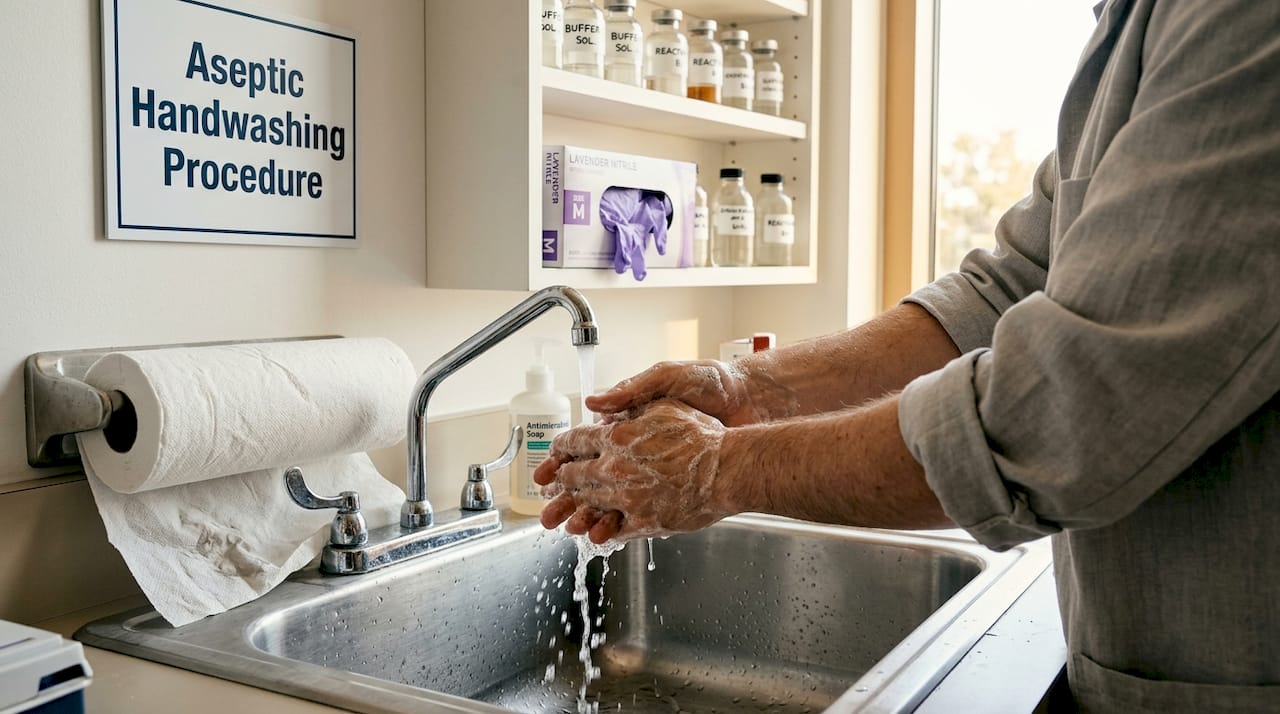
According to proper aseptic technique principles, you should wash your hands thoroughly before touching any equipment, wipe all vial stoppers with an alcohol swab and let them dry completely before insertion, and equalize vial pressure after adding water by venting air slowly. These steps are non-negotiable when you’re working with research compounds. Small contamination risks multiply across multiple doses.
Pro Tip: BAC water is preferred over sterile water for multi-dose peptide vials because the 0.9% benzyl alcohol content slows microbial growth. A single vial of reconstituted peptide used over days or weeks is much safer with BAC water. Sterile water, by contrast, should only be used if you plan to consume the entire vial immediately.
If you’re still learning the basics, the peptide reconstitution steps guide on The Peptide Guide walks through dosage math in detail. Understanding the core peptides you’re working with also matters, since different compounds have different solubility profiles and sensitivity levels. You can also reference detailed peptide classifications to understand structural differences that affect handling.
Step-by-step: Reconstituting peptide powders
With your materials prepared, follow these steps to reconstitute peptide powders correctly. Reconstitution, which means dissolving a lyophilized powder into a liquid solution, sounds simple but has several failure points that can silently damage your compound.
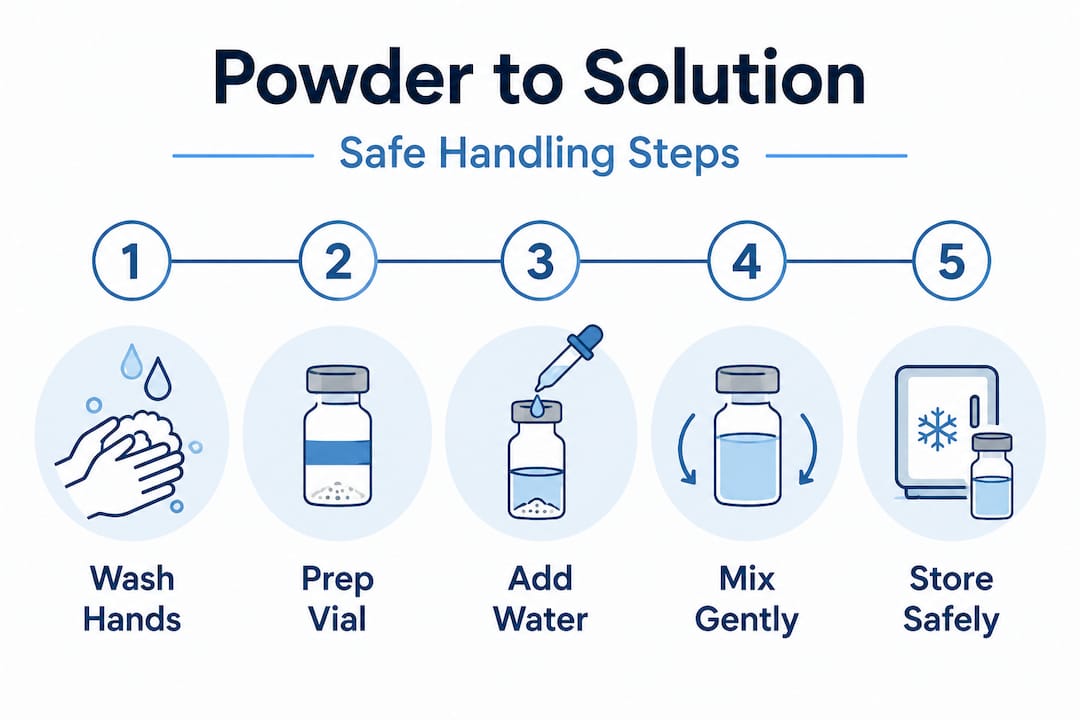
- Wash your hands thoroughly with soap for at least 20 seconds. Put on clean nitrile gloves if available.
- Wipe the stoppers of both the peptide vial and BAC water vial with separate alcohol swabs. Let both dry for 15-20 seconds. Never skip the drying step, since wet alcohol can dilute or contaminate your solution.
- Draw the calculated volume of BAC water into your insulin syringe slowly. Avoid introducing air bubbles.
- Insert the needle at an angle into the peptide vial and direct the stream of BAC water against the inner glass wall, not directly onto the powder. This gentle approach protects the peptide structure.
- Let the water flow down slowly from the vial wall into the powder. This keeps mechanical stress on the peptide chains to a minimum.
- Gently swirl the vial between your palms using slow circular motions for 30-60 seconds. Never invert and shake the vial like you might a saline solution.
- Inspect the solution under good lighting. It should be completely clear and colorless. Any cloudiness, floating particles, or unexpected color means the vial should be discarded.
- Label the vial immediately with the compound name, date of reconstitution, concentration (mcg or mg per mL), and your initials if multiple people share a workspace.
Pro Tip: If you’re pulling a vial from the refrigerator or freezer, allow it to warm to room temperature before opening. Cold glass can cause condensation to form inside when you introduce warmer air or liquid, which introduces unwanted moisture and increases contamination risk.
Important: Never shake the vial vigorously or jet the water directly onto the powder. Shear force from aggressive mixing breaks peptide bonds and causes denaturation. Vigorous shaking is one of the most common causes of a previously potent vial yielding a compromised solution. Swirl gently. Always.
For evidence-based guidance on how reconstitution fits into broader usage protocols, the peptide protocol best practices resource covers research-oriented application in depth. And for compound-specific discussions, peptide research insights is a useful reference library.
Storage and stability: Keeping peptides potent
To keep your peptides safe and effective, you need to store them properly before and after reconstitution. The rules differ significantly depending on whether the peptide is still in its dry, lyophilized powder form or has already been dissolved into a liquid solution.
| Feature | Lyophilized (dry powder) | Reconstituted (liquid solution) |
|---|---|---|
| Ideal temperature | -20°C (long-term), 2-8°C (short-term) | 2-8°C refrigerator |
| Typical shelf life | 1-2+ years at -20°C | 4-6 weeks (with BAC water) |
| Light sensitivity | High, use opaque or amber container | High, avoid direct light |
| Moisture exposure | Very harmful, use desiccant | Less relevant once dissolved |
| Freeze-thaw cycles | Minimize, once is generally acceptable | Avoid completely |
| What to avoid | Humidity, heat, repeated opening | Shaking, freezing, contamination |
Lyophilized powders stored at -20°C can maintain potency for one to two years or longer under ideal conditions. If you’re storing short-term and plan to reconstitute within a few weeks, a refrigerator at 2-8°C is sufficient. Just make sure the vial is sealed and protected from light at all times.
Once you’ve reconstituted a vial, the rules change. Freezing a liquid peptide solution causes ice crystals to form, which concentrates the peptide in localized areas and accelerates chemical degradation. For daily use, the refrigerator is always the right choice. Freezing reconstituted solutions should only be considered if you’re storing for infrequent, very long-term use, and even then you should minimize the number of freeze-thaw cycles as much as possible.
Here are the core storage rules to follow every time:
- Never remove more liquid from a vial than you need per session.
- Always re-swab the stopper before each withdrawal.
- Store all vials in a dedicated, clearly labeled container inside your fridge.
- Use desiccant packets in any area where dry powder vials are kept.
- Keep all peptide storage away from areas with temperature fluctuations, like near the fridge door or near kitchen appliances.
- Write the reconstitution date clearly on every vial. A label two weeks old tells you to plan ahead for a new vial.
For an overview of how storage decisions connect to broader research planning, the peptide protocols page covers how timing and storage fit into structured research cycles.
Common mistakes and troubleshooting tips
Even with the best setup, mistakes can happen. Here’s how to prevent and solve the most common ones.
The most frequent handling mistakes include:
- Shaking or vigorously swirling the vial during reconstitution
- Spraying BAC water directly onto the powder instead of the vial wall
- Opening a cold vial straight from the freezer without letting it warm first
- Using expired or improperly stored BAC water
- Forgetting to swab stoppers before each draw
- Storing reconstituted solutions in a freezer repeatedly
- Skipping labels and losing track of reconstitution dates or concentrations
- Reconstituting too many vials at once, forcing you to use solutions past their shelf life
Troubleshooting by scenario:
- Cloudy solution after reconstitution. Do not use it. Cloudiness indicates either contamination, degradation, or an undissolved aggregate. Try letting the vial sit at room temperature for 15 minutes and gently swirl again. If it stays cloudy, discard it. There is no safe way to reverse visible contamination.
- Powder won’t fully dissolve. Some peptides are naturally hydrophobic and dissolve slowly. Add a tiny drop of acetic acid (0.1% concentration) or dilute the BAC water further. Always consult compound-specific solubility notes before attempting this.
- You accidentally froze a reconstituted vial. One freeze-thaw cycle may be tolerable for some peptides, but repeated cycling is destructive. Inspect carefully for cloudiness after thawing, and consider this vial lower priority for your research timeline.
- You can’t remember when you reconstituted a vial. This is purely a labeling failure. Discard it to be safe. Unlabeled vials are a liability. Label with date and concentration every single time, without exception.
- BAC water smells off or looks cloudy. BAC water is good for approximately 28 days after opening when stored refrigerated. After that, the benzyl alcohol preservative degrades and bacterial contamination becomes a real risk.
Warning: BAC water has a shelf life of approximately 28 days after opening. Using BAC water beyond that window removes the antimicrobial protection you depend on for multi-dose vials. Date the BAC water vial on the day you open it.
Using the dose finder tool can help you avoid over-reconstituting by letting you calculate exactly how much solution you need. Reconstituting only the vials you’ll actually use within the next four to six weeks is one of the highest-leverage habits you can build.
A smarter way to work with peptide powders: What most miss
There’s a pattern among people who get consistent, reliable results with research peptides, and it has very little to do with which compound they’re using. It has everything to do with their process discipline.
Most handling errors aren’t dramatic. Nobody shakes their vial like a cocktail mixer on purpose. The mistakes are subtle: a label skipped because you were in a hurry, a vial left on the counter for an extra hour, a BAC water bottle used one week past its open date. These aren’t catastrophic moments. They’re invisible efficiency losses that accumulate over months of use.
Experienced users treat reconstitution like a lab protocol. They reconstitute only needed vials to protect powder stability in the stock that hasn’t been touched yet. They keep a simple log, even just a sticky note, noting vial name, date opened, concentration, and remaining volume. They use dosage calculators rather than estimating, because a small miscalculation in concentration compounds across every dose.
The “measure twice, mix once” mindset matters here more than in most contexts. You cannot visually inspect a peptide for potency. A degraded solution looks identical to a healthy one. Your only reliable protection is the process itself. If your process is solid, your results will be consistent. If you cut corners, you’ll never know exactly where your results went sideways.
The uncomfortable truth for a lot of fitness-oriented researchers is that peptide handling feels like a lot of structure for something they want to be straightforward. But the structure is the point. The ten minutes you invest in proper technique and labeling is worth far more than the cost of any single vial.
Your next step: Expert resources for peptide handling
If this guide helped you see where your current process could tighten up, the next move is to go deeper on the specific areas that matter most for your research setup. The Peptide Guide has purpose-built resources for exactly that.
Start with the full peptide reconstitution guide, which covers dosage math, concentration calculations, and solubility troubleshooting in detail. If you want a clear overview of safe handling standards, the peptide safety guidelines page organizes the most important protocols in one place. And for connecting your handling practices to structured research cycles, peptide protocol best practices gives you an evidence-grounded framework for timing, dosing, and documentation. These resources are built to help you move from careful beginner to confident, consistent practitioner.
Frequently asked questions
How long can peptide powders be safely stored?
Sealed lyophilized powders can last one to two years or more at -20°C; refrigerated storage at 2-8°C is suitable for short-term use of a few weeks to months, provided the vial is protected from light and moisture.
What is the best water for dissolving peptide powders?
Bacteriostatic water is the standard choice for multi-dose vials because the benzyl alcohol content inhibits bacterial growth, making it far safer than plain sterile water when a vial will be accessed multiple times over days or weeks.
Can I freeze reconstituted peptides?
Freezing reconstituted solutions is not recommended for regular use because ice crystal formation concentrates and degrades the peptide; refrigerated storage at 2-8°C is the right call for any vial you’re actively using.
How do I know if my peptide solution is usable?
A usable solution should be completely clear and colorless; if you notice cloudiness, visible particles, or any unexpected color change, discard the vial immediately rather than risk using a degraded or contaminated compound.
Recommended
- Step By Step Guide To Peptide Reconstitution & Dosage Calculations | The Peptide Guide
- Home | The Peptide Guide
- Evidence Based Peptide Protocols Best Practices For Research Success | The Peptide Guide
- Research Insights | The Peptide Guide
- How to mix peptides: a precise guide for researchers
- Compounded Peptide Stability | RenewMD


